

At the beginning of my book Truth Decay – How Bitcoin Fixes This, just before the introduction, I included a short exchange:
“That’s not fair,” said the child.
“Life isn’t fair,” said the parent.
“That’s wrong,” said the inner child, “We should at least try to make it fair!”
“What is fair?” said the World.
When I was producing the book, I hired an editor and asked to see her initial notes so that I could assess how she was progressing. Her very first comment appeared beside this page:
“What’s this?”
She was clearly unimpressed. Perhaps this strange little exchange sitting on its own before the introduction simply didn’t conform to the rules she was accustomed to when editing books. I ignored her and included it anyway, because to me those few lines encapsulated much of what I was trying to understand.
As I think about it now, perhaps they encapsulate something I have been trying to understand for most of my life.
Every child has probably encountered a rule they regard as unfair. “It’s not fair!” is one of the great refrains of childhood, and it certainly was one of mine. We begin life with an extraordinarily powerful sense that things ought to be fair, long before we have developed any sophisticated understanding of what fairness actually means.
Perhaps that is where my fascination with rules began.
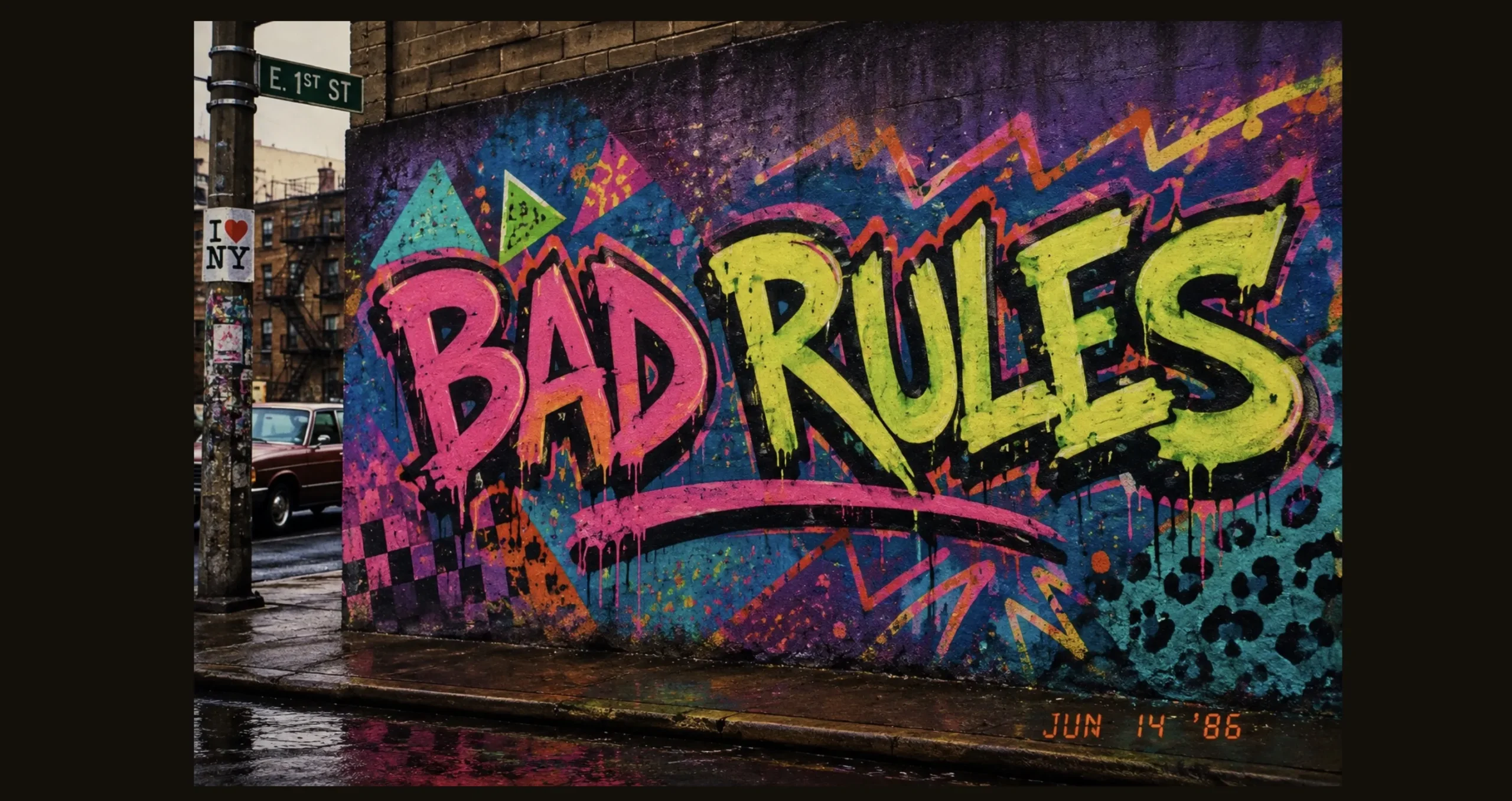
Long before I wrote Truth Decay, I had considered writing a very different book. I was going to call it Bad Rules. Throughout my life I had noticed systems that seemed to produce outcomes completely at odds with what they were supposedly designed to achieve, and I wanted to understand why.
The trouble was, the subject was enormous. Where would I even begin?
By then I had also discovered Bitcoin, and Bitcoin seemed to offer me something far more hopeful. Rather than writing a book cataloguing all the problems created by bad rules, perhaps I could write about a system whose rules might actually produce something better. As the daughter of a Naval Officer, I had always been encouraged to “bring the solution rather than emphasise the problem.”
Bitcoin appeared to be that solution.
So Bad Rules was put to one side, and Truth Decay took its place.
Perhaps Bitcoin was the answer
What fascinated me about Bitcoin wasn’t simply that it was a new form of money. It was the ingenious way its rules tried to accommodate human nature. Bitcoin didn’t depend upon politicians behaving responsibly, bankers resisting temptation or participants acting virtuously for the greater good. Instead, it tried to balance incentives and competing interests so no single participant could easily impose their will on everyone else.
I found that idea extraordinary.
Perhaps, I thought, rather than continually trying to create better human beings, we could create better rules.
Much of my work over the following years grew from that belief. I studied Bitcoin, wrote about it, spoke about it and eventually learned how to operate some of its infrastructure for myself.
Yet, as I have described throughout the previous four newsletters in this series, recent events have unsettled some of that confidence.
I am not concluding that Bitcoin has failed, nor am I abandoning everything I have learned about it. I remain fascinated by its monetary properties and by the ingenuity of its design. But I am less certain today that decentralisation is an inherent property that, once engineered into a system, can simply be taken for granted.
Perhaps decentralisation itself has to be continually maintained.
Perhaps Bitcoin will succeed in doing that. Perhaps it won’t.
I don’t know.
But strangely, that uncertainty has taken me back to the book I never wrote, because Bitcoin wasn’t actually the first place I encountered the problem of rules producing unexpected outcomes.
I had already spent years experiencing it in dentistry.
How could a dentist do that?
I remember that as dental students, my colleagues and I would sometimes gaze in horror at the work we found in our patients’ mouths. We were being taught how dentistry was supposed to be performed, yet properly qualified dentists had done some of the work we encountered, and it fell far short of those standards.
In the arrogance of youth, we found this almost incomprehensible. How could someone who had completed the same training we were undertaking possibly produce work like this?
It didn’t take many years in practice for me to acquire a rather more sympathetic understanding.
Once I began working within the National Health Service (NHS), I discovered that a procedure for which I might have been given an hour in the protected environment of dental school now had to be completed in perhaps twenty minutes. At the same time, patients cancelled or failed to arrive, equipment broke down, staff needed paying, and the practice somehow had to remain financially viable.
Suddenly I was no longer looking at the outcome in isolation. I could see the system that had produced it.
That didn’t necessarily excuse poor dentistry, but it changed the question I was asking. Instead of wondering, “What is wrong with this dentist?”, I began wondering, “What is it about the environment in which a dentist is working that makes this outcome more likely?”
That distinction fascinated me, and it followed me throughout my career.
Eventually I established my own dental practice and decided to operate completely outside the NHS. I wanted sufficient time to examine patients properly and understand why problems had occurred before simply repairing the damage, so I developed my own comprehensive assessment protocol.
One day a man came to see me because he wanted his front crowns replaced. His front teeth had already been heavily restored, but instead of simply assessing the crowns, I examined his mouth more comprehensively and concluded that part of the problem was how his teeth met. He had a crossbite, and his front teeth appeared to be receiving excessive forces during everyday function.
I remembered something I had briefly encountered while studying orthodontics. Was it possible, in some circumstances, to expand the upper jaw and address the underlying problem rather than simply replace the damaged restorations?
I started asking questions.
A local orthodontist came to see me and examined models of the patient’s teeth. He told me that what I was considering couldn’t be done in the way I imagined. Attempting to expand the arch in that manner, he explained, risked moving the teeth beyond their supporting bone.
I could have accepted that. He was, after all, the specialist.
But I have always found it difficult to accept an explanation simply because someone in authority tells me it is so, particularly when it doesn’t make sense to me.
So I investigated.
Eventually I discovered a very different school of thought and attended courses taught by a practitioner who strongly disagreed with aspects of conventional orthodontic thinking. He believed that techniques dismissed by the wider orthodontic establishment could be used successfully, and his explanations made sense to me.
I learned the techniques, incorporated aspects of them into my practice, and I achieved some excellent results. I became confident enough in some of the work that I later wrote up a series of cases for publication in a professional journal.
At the time, this seemed to confirm something I had believed for much of my life: authority should be questioned. Experts can be wrong. Established systems can become trapped within their own rules and assumptions.
Then something happened that forced me to confront the other side of that argument.
A patient challenged me legally.
What followed lasted approximately five years. As the legal process unfolded, I discovered how difficult it is to defend work that sits outside approaches supported by the established orthodontic bodies.
I could turn this into an argument about orthodontics.
I’m not going to.
Because looking back now, I think the more interesting question is not whether I was right.
It is how I decided what to believe.
I had encountered an established authority whose explanation didn’t satisfy me, so I questioned it. That sounds like critical thinking.
But then I discovered another authority whose explanation made considerably more sense to me, and I found myself moving in a new direction.
Was that critical thinking?
Or had I simply replaced one authority with another whose ideas fitted my own instincts rather better?
That question is much harder.
When scepticism isn't enough
I have always regarded scepticism as a strength. It has led me down some fascinating paths and encouraged me to investigate subjects I might otherwise have ignored.
But perhaps scepticism and critical thinking aren’t quite the same thing.
Institutions can be wrong. Experts can become trapped within established ways of thinking. Rules can survive long after the circumstances that created them have disappeared. Incentives can distort professional judgement, and consensus does not magically turn an incorrect idea into a correct one.
But the dissenter can be wrong too.
And, perhaps most uncomfortably, I can be wrong.
Rejecting authority doesn’t solve the problem of determining what is true. It merely removes one shortcut.
There are, after all, good reasons why dentistry has professional standards. A patient can’t reasonably be expected to spend years studying dentistry before deciding whether the treatment their dentist recommends is appropriate. We therefore create institutions to perform some of that work for them.
Universities train professionals. Regulators establish standards. Professional bodies issue guidance. Researchers produce evidence. Courts and expert witnesses help determine whether acceptable standards are breached when something goes wrong.
Those structures could protect patients.
But my experiences left me with another question. What happens when an established model itself is wrong?
If the professional consensus is correct, institutional resistance to unconventional treatment may protect patients from harm. But if the consensus is wrong or incomplete, some of those same mechanisms can make challenging it extraordinarily difficult.
How is somebody – particularly somebody without specialist knowledge – supposed to distinguish between those possibilities?
I don’t think there is an easy answer.
And increasingly, I realise that this problem extends far beyond dentistry.
Back to Bad Rules
Looking back now, perhaps Bad Rules was never really abandoned. I simply became distracted by something I thought might provide the answer.
For years I have written about money, banking, government, regulation and Bitcoin, but underneath all of those subjects I seem to have been pursuing the same question:
Why do systems designed to produce good outcomes so often produce bad ones?
Even that question, however, now seems too simple.
Perhaps sometimes the rules really are bad. Perhaps perfectly sensible rules create incentives nobody anticipated. Perhaps circumstances change while the rules remain the same. Perhaps people discover how to exploit them. Perhaps an institution gradually becomes more concerned with preserving itself than fulfilling the purpose for which it was created.
Perhaps what looks like failure is actually the least-bad compromise available.
And sometimes, as my experience with Bitcoin has taught me, the problem may be that I have misunderstood what I am looking at.
This is where I think my investigation needs to go next.
I don’t want to spend the next few years compiling a catalogue of everything that is wrong with the world. Nor do I want to replace “Bitcoin fixes this” with another comforting certainty that institutions are corrupt, experts can’t be trusted, or rules inevitably go wrong.
That would simply replace one worldview with another.
I would rather go back and look again.
Why was a particular rule created? What was happening at the time? What problem were people trying to solve? What happened afterwards? How did people adapt their behaviour to the rules? Who gained power and who lost it? And when the outcome wasn’t what people expected, was the rule really the cause?
Perhaps most importantly, I want to become better at asking what evidence would persuade me that my own explanation is wrong.
Sometimes I expect to discover genuinely bad rules.
Sometimes I may discover good rules producing unexpected consequences.
And occasionally I may discover that a rule I thought was ridiculous exists for a very good reason.
That’s rather more uncomfortable.
But perhaps discomfort is the point.
Because the World answered the child at the beginning of Truth Decay with a question:
“What is fair?”
Six years later, I think I am finally beginning to appreciate why that question is so difficult.
Perhaps our challenge isn’t simply to identify bad rules. It is to understand why systems produce the outcomes they do – and how we can tell whether changing the rules would actually make things better.
That seems like a question worth pursuing
Until next time, enthusiasts!
Victoria
The Eve of a Bitcoin Hard Fork
In this episode of the World Crypto Network, we discuss upcoming hard forks, which require a comprehension of Bitcoin’s rules and who makes them.