My interest in Bitcoin began with a much broader question: how does our financial system actually work?
That question led me into the history of money, banking and debt, and eventually to Bitcoin. What fascinated me most was not simply Bitcoin as a new form of money, but the possibility that a decentralised system of rules might distribute power differently.
Over the years, I have written extensively about money, Bitcoin, decentralisation and the political and economic systems surrounding them. My thinking has continued to evolve, and some of my more recent work questions conclusions I once held with considerable confidence.
I have gathered those articles here because, taken together, they document an ongoing investigation into money, governance and the rules that determine who holds power within a system.
Some offer answers. Others have since led me to better questions.
Explore the articles below.
Bitcoin & Free Trade
The world faces economic uncertainty with rising debt and risky fiscal strategies recently escalated with global tariffs. What options does Bitcoin provide, or is it too soon for such a radical shift? Explore an analysis of Trump’s recent tariff war and the alternative with the potential for a decentralised financial future.
This article critiques the UK’s rising government spending and debt, arguing that Labour Chancellor Rachel Reeves’ borrowing strategy is a high-risk gamble. It warns that mismanaged investments and high taxes could lead to economic stagnation, similar to Japan’s “Lost Decade.” I propose adopting Bitcoin as a currency and alternative, emphasising its fixed supply, transparency, and resistance to reckless borrowing. However, volatility and the lack of a central bank make adoption difficult. However, I believe that the organic adoption of Bitcoin will overcome these obstacles over time.
Historically, gold and silver were reliable but impractical forms of money, leading to the rise of paper currencies. However, moving away from gold-backed money enabled manipulation and debt-driven economies.
Bitcoin counters these issues. Its decentralized structure and fixed supply resist inflation and central control. Unlike gold, it is divisible, verifiable, and suited for modern trade. As digital currencies like the EU’s digital euro emerge, Bitcoin’s ability to restore monetary honesty and empower individuals becomes increasingly relevant.
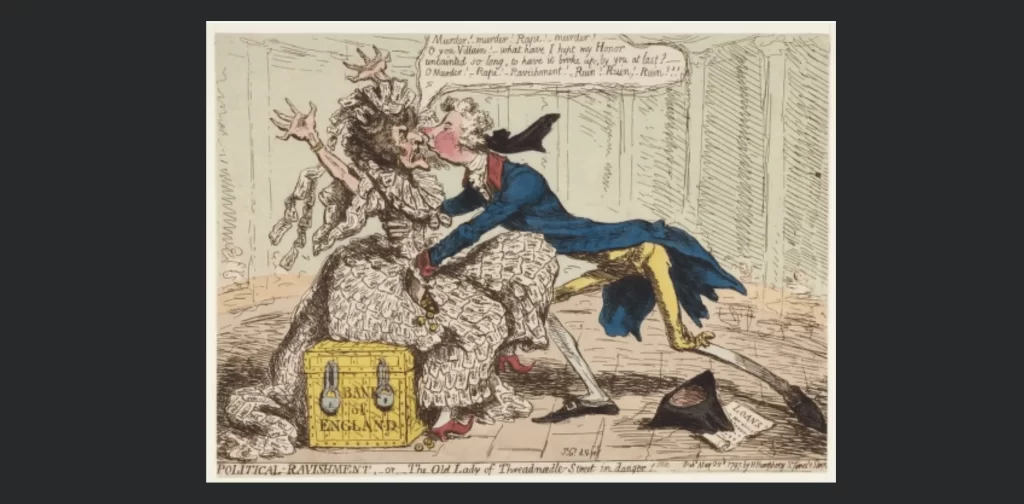
This article examines the history of taxation and government debt, from medieval tithes to modern policies, highlighting recurring issues of mismanagement and unsustainable borrowing. Historical examples like the Southsea Bubble and Napoleonic Wars illustrate the consequences of financial overreach.
In modern times, UK economic strategies, whether Conservative or Labour, are critiqued for failing to address the nation’s £2.6 trillion debt effectively. The article proposes Bitcoin as a transformative solution, offering decentralization and transparency to prevent manipulation and promote accountability in public spending. Despite its potential, widespread adoption faces resistance from those benefiting from the current system.
Since Bitcoin’s inception, it has frequently drawn comparisons to the Tulip Mania of the 17th century, where the price of tulip bulbs skyrocketed and then crashed dramatically. While Bitcoin has experienced similar surges and declines, its resilience over 15 years sets it apart from the short-lived Tulip Bubble. This essay explores the historical context of financial bubbles, the evolution of legal and economic structures, and the unique characteristics of Bitcoin that differentiate it from past speculative frenzies. By examining the encoded rules of Bitcoin and its resistance to governmental manipulation, we uncover why Bitcoin is poised to be a revolutionary asset in the financial world.
As Western democracies face a year of elections, this article outlines how money has supported the development and growth of politics and governments through the last 300 years of history. Governments need the support of central banks to continue to function. I explore how that will change in a new economic world based on Bitcoin.
Do you need clarification on the subject of inflation? Read here as Victoria explains how the problem of inflation has evolved since the creation of the Bank of England four hundred years ago, and learn how knowing this can help you navigate current circumstances.
The world’s financial system does not just rely on central banking; in fact, companies’ need for banking services drove their invention. Discover the potential consequences in this latest newsletter as the US Securities Exchange Commission approves exchange-traded funds for Bitcoin.
In this newsletter, Bitcoin & Debt, I enlighten you on how debt, rather than gold, has become the foundation of our modern money system. I provide another chapter, assisting you in successfully navigating our world’s financial minefield and emphasising why this makes Bitcoin, as a form of sound money, so important.
Do you want to know how banking evolved? Do you want a more straightforward understanding of why the financial system is as complicated as it is today? Life has taught me that something is usually being hidden when things get complex. The truth is often far simpler than you think. By exploring history, we will find the answers to the evolution of the complexities of modern banking in this newsletter.
In this article, Victoria discusses the circumstances surrounding the South Sea Bubble in 1720 and how the creation of currency led to a financial crisis, which impacts us even today. There were limited solutions then, but now Bitcoin can fix this.
If Bitcoin is Digital Gold, what would it mean if it allowed us to replicate The Gold Standard? Find out with an analysis of the issues with this newsletter.
The United Nations would have us believe they are making remarkable progress in reducing poverty, but are they? The nature of our money makes the most significant difference, as Victoria discusses here in her latest article.
Using the analogy of Bitcoin as Digital Money and Ethereum as Digital Law, Victoria discusses the impact each technology will have on our understanding of money and the implications for our future.