

In my last newsletter, I explained why, after almost ten years of advocating for Bitcoin, I found myself questioning something I thought I understood.
Who actually governs Bitcoin?
It is a question I have been thinking about ever since.
When I first discovered Bitcoin, I had already spent considerable time researching the history of money.
That history had taught me to be deeply suspicious of the concentration of monetary power.
Gold had historically provided a constraint because its supply could not simply be manufactured at will. But gold also has disadvantages. It is heavy, difficult to transport and costly to verify and secure.
Over the centuries, increasingly sophisticated financial institutions emerged to solve these and other problems. Eventually, instead of exchanging physical gold, people could transact using claims upon it.
The difficulty is that once we place an intermediary between ourselves and our money, we also create power.
And history provides plenty of examples of what can happen when monetary and political power become intertwined.
Governments have financed wars through monetary expansion and debt. Currencies have been debased. Banking systems have failed. Savings have been destroyed through inflation.
This history is what made Bitcoin so fascinating to me.
Bitcoin didn’t promise to solve the problem by finding more trustworthy people to control our money.
It attempted something much more radical.
It designed a monetary system without a ruler.
Who makes Bitcoin's rules?
I used to think I understood the answer to this fairly well.
Nobody does.
Or perhaps, more accurately, everybody does.
But the more I have looked at Bitcoin’s governance, the more I realised that neither answer is quite satisfactory.
Bitcoin doesn’t have a board of directors.
There is no Bitcoin CEO.
No government department can pass a law that changes Bitcoin’s maximum supply from 21 million to 42 million.
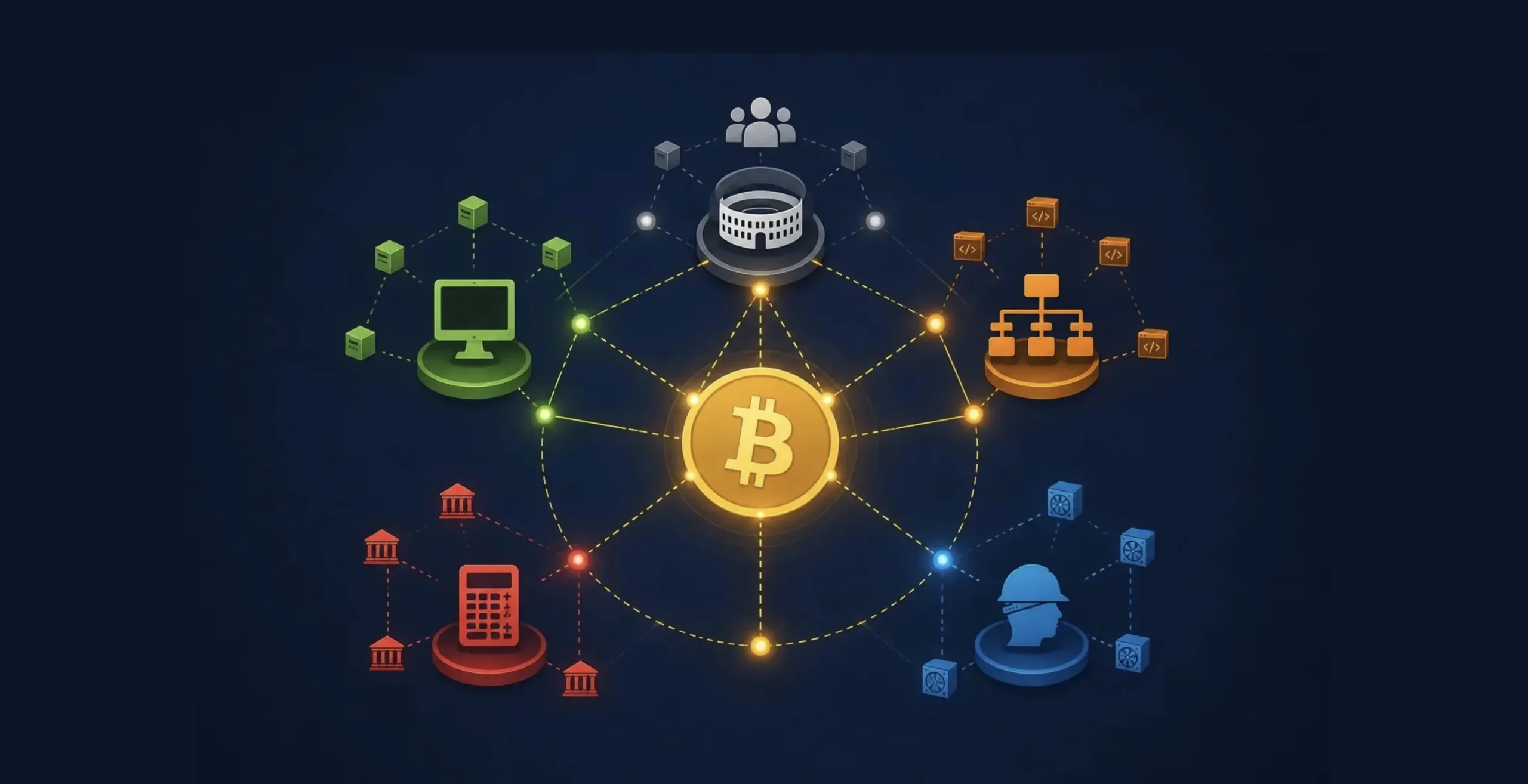
Instead, authority is distributed between different participants who possess different kinds of power.
Developers propose and write software.
Bitcoin Core – the most widely used implementation of Bitcoin – is itself an open-source project. Anyone can propose changes, test software or review code. Maintainers can merge changes into the Bitcoin Core codebase, but Bitcoin Core itself explicitly says its developers do not decide Bitcoin’s consensus rules. Users choose which software they run.
Node operators independently verify transactions and blocks according to the consensus rules in the software they choose.
Miners expend enormous amounts of energy constructing blocks and deciding which valid transactions to include.
Then there are exchanges, businesses, investors and ordinary Bitcoin users, who ultimately decide which network and which asset they are prepared to recognise and give economic value to.
No single group possesses all of these powers.
And therein lies the genius – and perhaps the difficulty – of Bitcoin.
What does running a node actually give me?
This is something I’ve had to reconsider.
I spent years learning how to operate my own Bitcoin infrastructure because I believed running a node was an important part of Bitcoin’s decentralisation.
I still believe that.
But I now understand my node’s power differently.
Suppose tomorrow a group of miners decided that instead of following Bitcoin’s existing issuance schedule, they were going to award themselves 100 new bitcoins with every block.
They could produce those blocks.
They could devote enormous amounts of computing power to them.
But my node would reject them because they violated the consensus rules my software was enforcing.
Miners cannot force my node to accept something it considers invalid.
That is an extraordinary property.
But there is another side to it.
Suppose I change the rules my node enforces.
I can do that too.
I can refuse to recognise blocks that don’t comply with my preferred rules.
But that doesn’t mean everybody else has to follow me.
And this has led me to an important realisation:
Running my node gives me the power to refuse rules I don’t accept. It doesn’t give me the power to make everybody else accept mine.
That distinction turns out to be extremely important.
The Block Size War
Bitcoin has faced this problem before.
Perhaps the most famous example occurred during the long-running scaling dispute that culminated in 2017 and became known as the Block Size War.
Bitcoin had a problem.
As the network grew, people disagreed profoundly about how it should scale.
One important proposed upgrade was Segregated Witness, usually shortened to SegWit.
SegWit had several technical benefits, but its original activation mechanism required a very high level of miner signalling – 95%.
That threshold wasn’t being reached.
This created a fascinating political question.
If users wanted a change but miners weren’t signalling for it, who should decide?
Some Bitcoin users offered a remarkable answer.
They proposed BIP 148, the User Activated Soft Fork.
Rather than waiting indefinitely for miners, people running BIP 148 software would, from 1 August 2017, begin rejecting blocks from miners that failed to signal support for SegWit.
Translated out of the technical language, their position was essentially:
These are the blocks we’re prepared to recognise. You can mine something else if you wish.
They couldn’t command the miners.
But they could refuse to follow them.
The interesting thing is that the threatened confrontation never had to play out fully.
Before BIP 148 took effect, miners coordinated around another proposal, BIP 91, which used a lower 80% miner threshold to coordinate signalling for SegWit. SegWit subsequently locked in.
Meanwhile, a separate disagreement about Bitcoin’s scaling direction resulted in a group pursuing larger blocks and creating a new chain: Bitcoin Cash
The Bitcoin ecosystem had demonstrated two possible outcomes.
Coordination.
And:
Separation.
Nobody could prevent a group from creating Bitcoin Cash.
But that group couldn’t compel everyone else to accept its chain as Bitcoin.
The economic network ultimately decided what it valued.
Nine years later
Which brings me back to BIP 110.
As I described in my previous newsletter, the disagreement surrounding Bitcoin Core 30 eventually escalated beyond the question of which transactions nodes should normally relay.
BIP 110 proposed something considerably more consequential: temporary restrictions on several forms of arbitrary data at the level of Bitcoin’s consensus rules.
Its stated purpose was to restrict arbitrary-data use and refocus Bitcoin on its role as money. It included a 55% miner-signalling threshold and, if that wasn’t reached, a later period of mandatory signalling in which nodes enforcing BIP 110 would reject blocks that failed to signal appropriately.
The voluntary support wasn’t sufficient.
When mandatory signalling eventually arrived in August 2026, the BIP 110-enforcing chain stalled after only two blocks.
And suddenly the lesson of 2017 became much clearer to me.
The people running BIP 110 had every right to decide which rules their own nodes would enforce.
But they didn’t have the power to make everybody else follow them.
Their nodes could refuse.
They could not command.
Did Bitcoin's governance actually work?
This leaves me in a rather strange position.
The events I described in my previous newsletter initially made me question whether Bitcoin was really as decentralised as I had believed.
After looking more closely at how Bitcoin’s governance actually works, I am beginning to wonder whether I was asking the wrong question.
Perhaps what happened wasn’t evidence that Bitcoin’s decentralisation had failed.
Perhaps it demonstrated decentralisation rather well.
Bitcoin Core changed the default relay and mining policy in its software concerning data-carrying transactions. Importantly, Core 30 did not change Bitcoin’s consensus rules, and node operators remained free to configure the previous data-carrier limit themselves or run different software.
People who strongly disagreed could run Bitcoin Knots.
Others could propose BIP 110.
Miners were free to decide whether to support it.
Node operators were free to enforce it.
And the rest of the network was free not to follow them.
Nobody possessed complete authority.
Perhaps the system worked exactly as designed.
But that doesn’t completely resolve my concern.
Because a decentralised process can work perfectly and still produce an outcome some participants believe is undesirable.
The question behind the question
I remain uncomfortable with the direction Core 30 represents.
However, I need to correct a previous belief.
Core 30 did not suddenly make it possible to put arbitrary – or potentially illegal – data into Bitcoin. People have embedded data in Bitcoin transactions in various ways for many years.
Bitcoin Core 30 changed the default rules for how certain transactions containing extra data are handled. Previously, this data was generally limited to 83 bytes, but the default limit was increased to 100,000 bytes, effectively removing that restriction. It also allowed transactions with multiple OP_RETURN outputs to be relayed and mined by default. However, individual Bitcoin node operators can still choose to restore the previous limit.
Supporters of the change have argued that the restrictions previously in place were ineffective at disallowing illegal data onto the blockchain, because people who want to embed such data can circumvent them using other methods. Restrictive relay policies may therefore move the data elsewhere rather than prevent it.
I understand that argument better than I did a year ago.
But I am not yet persuaded that the moral question can simply be reduced to what is technically preventable.
In my mind, there is a difference between a monetary network being capable of facilitating transactions I find objectionable and making arbitrary data storage an increasingly normal use of the infrastructure itself.
That distinction is difficult to maintain.
Enforcing it creates worse problems.
Those are questions I still need to explore.
But there is a bigger issue here.
If Bitcoin is ultimately going to become a form of money used by ordinary people – not merely a fascinating technological experiment – then technical possibility cannot be the only consideration.
Human beings make moral judgments.
Societies create laws.
People decide which technologies they are prepared to adopt.
And widespread adoption ultimately requires some degree of social legitimacy.
So I find myself asking a different question from the one I started with.
Bitcoin doesn't eliminate politics
For years I have described Bitcoin as not merely a new form of money, but something approaching a new political system.
I still think that description has merit.
But I’d express it differently now.
Bitcoin doesn’t eliminate politics. It creates a political system in which nobody has complete authority.
Developers can propose.
Maintainers can merge.
Nodes can refuse.
Miners can mine.
Businesses can choose.
Markets can value.
But nobody can simply command everybody else.
That may be one of Bitcoin’s greatest strengths.
The question I’m interested in now is whether distributing power this way necessarily produces better outcomes.
Or does it merely produce outcomes that nobody possesses sufficient authority to prevent?
History is full of attempts to solve this problem.
Kings have shared power with nobles.
Parliaments have challenged monarchs.
Constitutions have divided authority between different branches of government.
Markets coordinate millions of people without anybody directing the whole system.
Churches, corporations and political movements have all wrestled with the problem of who gets to make the rules.
Sometimes distributed power has created extraordinary resilience.
Sometimes it has created stalemate.
Sometimes competing factions have torn systems apart.
And sometimes supposedly decentralised institutions have gradually recentralised around new centres of power.
So perhaps the question I need to investigate next is no longer simply:
Who governs Bitcoin?
I think I understand the answer better now.
Nobody governs it completely.
Instead, different participants possess different forms of power and constrain one another.
The harder question is:
Does a system in which nobody has complete authority necessarily make better decisions?
I don’t know.
But human beings have been experimenting with that question for thousands of years.
Perhaps history can help us answer it
Until next time, enthusiasts!
Victoria
The Debate Continues
By the end of September 2025, the Bitcoin Core 30 debate was heating up as the Knots lead developer recommended a Hard Fork. You can watch the discussion here.