

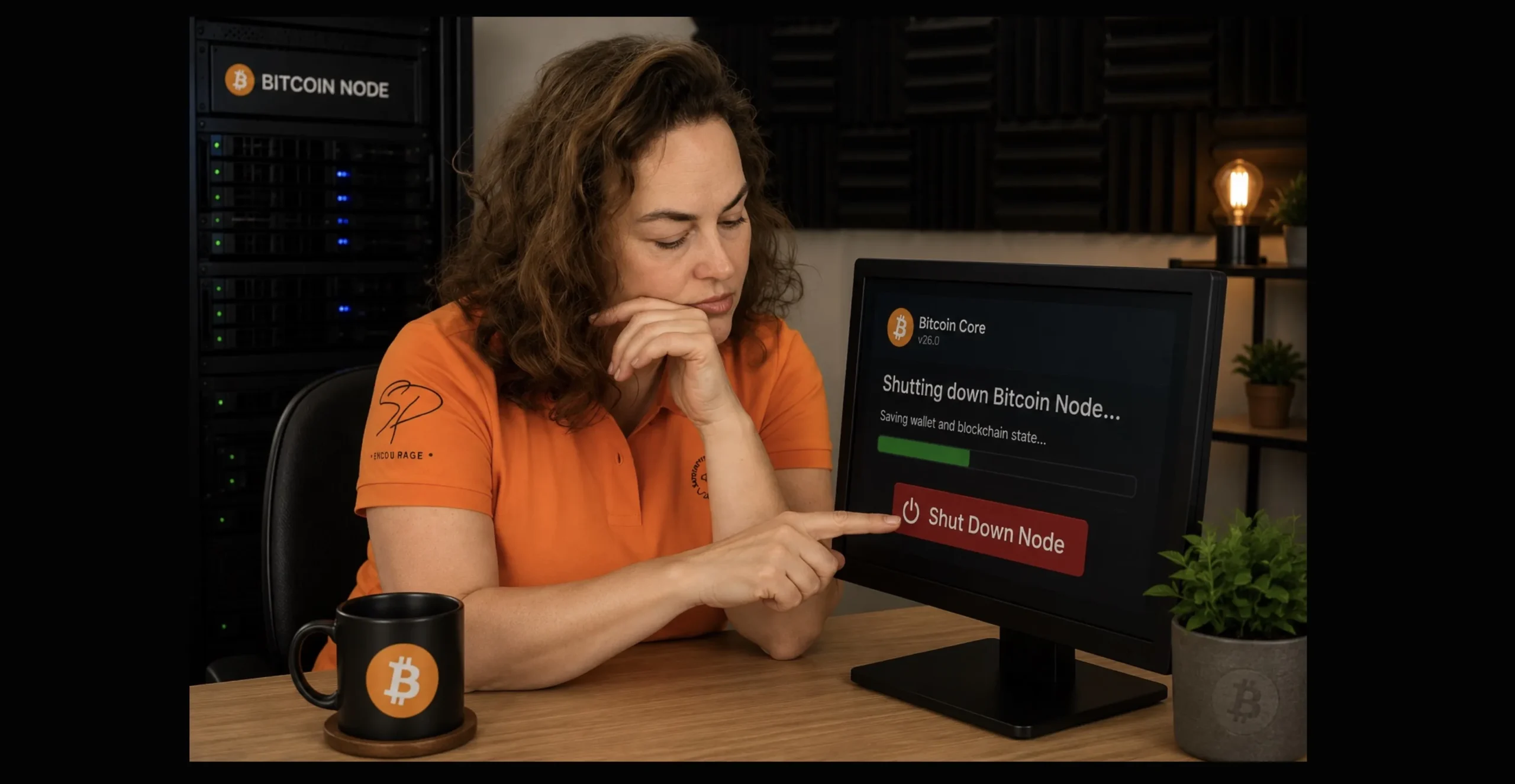
I have been away for a while. Thinking, contemplating and observing.
For almost ten years, I have been involved with Bitcoin. During that time, I have written extensively about it, spoken at conferences, written a book and spent countless hours trying to understand not only how Bitcoin works, but why it matters.
Last year, however, something happened that caused me to stop.
At the time, I was working with my colleague Darren to create a series of courses teaching people how to build and operate their own Bitcoin nodes. It was a time-consuming endeavour.
My background isn’t technical. I originally trained as a dentist and later became a business owner. But I have endless curiosity, and when I discover something interesting, I like to understand it from the foundations and then explain it to others.
That was how I approached Bitcoin.
Down the Rabbit Hole
When I first discovered Bitcoin, I became fascinated by its potential as a form of sound money.
My interest began years earlier, after I tried to build a business during the Great Financial Crisis. That experience led me towards monetary history and eventually towards Bitcoin.
The more I learned, the further down the rabbit hole I went.
I wanted to understand how this strange new monetary system actually worked.
So, despite having no background in software development, I started reading Andreas Antonopoulos’s Mastering Bitcoin. Much of the language was completely new to me, but to my amazement, I could follow it.
Eventually I became interested in a much more practical question:
How can an ordinary business accept a payment without relying upon a bank?
At a conference in 2019, I learned about BTCPay Server, an open-source payment-processing system that, along with Bitcoin, seemed to provide an answer.
There was just one problem.
To use it as I wanted, I needed to understand how to run my own Bitcoin infrastructure.
And so began another journey.
I initially ran a Bitcoin node in the cloud, then moved to my own hardware. Eventually, because I wanted to accept small payments through my website, I also learned how to operate Lightning channels.
None of this came naturally to me.
Setting everything up took a lot of time, experimentation, and help from people with more technical expertise than I had.
But eventually it worked.
For a while, readers could even make micropayments for newsletters on my website.
I found that enormously exciting.
More importantly, running my own node made decentralisation tangible.
I wasn’t simply buying Bitcoin and hoping its price increased. I was involved in the network’s infrastructure.
That eventually led Darren and I to create courses to help others do the same.
And then, in September 2025, I returned from holiday.
Something had changed
I noticed that the payment system on my website wasn’t working.
When I looked into it, I discovered my Lightning channels had been closed.
What seemed like a technical problem led me into a much bigger story.
While I had been focused on other things, a fierce argument was developing within Bitcoin.
Earlier that year, Bitcoin developers debated a relatively obscure setting about how nodes relay transactions containing arbitrary data.
This involved something called OP_RETURN.
You don’t need to understand the technical details yet – I intend to return to those in a later newsletter.
The key point is that Bitcoin Core, the most widely used implementation of Bitcoin’s software, was preparing to change its default policy on how much data nodes would relay in certain transactions.
The proposal was controversial.
Some Bitcoin developers argued that the existing restrictions had become ineffective. People wishing to put data into Bitcoin transactions could already circumvent them in other ways. Maintaining an artificial restriction, they argued, could actually create worse consequences by encouraging alternative methods of storing or transmitting the data.
Others strongly disagreed.
They worried about blockchain growth, the burden on people running nodes, the use of Bitcoin to store arbitrary material, and the potential legal and moral consequences if objectionable or illegal data were embedded in transactions.
This was the argument I stumbled into
And it immediately bothered me.
The problem of running a node
While Darren and I were creating our courses, one thing had already given me pause.
Setting up a new Bitcoin node can take a surprisingly long time.
A new node must obtain and verify the blockchain’s history. Bitcoin has existed since 2009, so that history is already substantial.
I remember wondering:
What will this process look like in another hundred years?
Storage gets cheaper, and technology improves, of course. Nodes can also be pruned so that they don’t retain the entire historical blockchain.
Nevertheless, the experience had made something very obvious to me.
If Bitcoin’s decentralisation depends partly on ordinary people being able to run nodes, then keeping the burden manageable matters.
That was why I could understand the concerns being raised.
Another issue bothered me.
Bitcoin’s blockchain is designed to be extraordinarily difficult to alter retrospectively. If arbitrary data were incorporated into it, what would happen if that data contained material that was illegal to possess or distribute?
I didn’t know how serious that legal risk actually was.
I still don’t think it should simply be dismissed.
So I watched.
Core 30
The argument continued through 2025.
In June, the controversial change was merged into the code intended for the next major Bitcoin Core release. Then, on 10 October 2025, Bitcoin Core 30.0 was released.
Core 30 did not change Bitcoin’s consensus rules.
Instead, it changed the default policy Bitcoin Core uses to relay and mine certain data-carrying transactions. Individual node operators could still configure their software differently.
That distinction matters, and I intend to explore it properly in a later newsletter.
Nevertheless, at the time, I found how the disagreement unfolded deeply uncomfortable.
A vocal group of node operators objected strongly to the change, yet the change to Bitcoin Core’s defaults proceeded.
To me, it felt like a fait accompli.
And that collided with something I thought I understood about Bitcoin.
Who gets to decide?
For years, I’ve explained Bitcoin as a decentralised system.
No government controls it.
No company controls it.
Miners cannot simply rewrite its rules.
Developers cannot simply dictate what Bitcoin is.
Node operators independently choose the software and rules they are prepared to accept.
This absence of a central authority is precisely what makes Bitcoin so interesting.
Yet now I was watching a bitter disagreement between people who all considered themselves defenders of Bitcoin.
And I realised that my mental model was too simple.
Some node operators began moving towards Bitcoin Knots, an alternative implementation of Bitcoin software that offered different filtering policies.
Another clarification is important here.
Bitcoin Knots wasn’t created because of this controversy, and it wasn’t itself a soft fork. It had existed for years.
But during this dispute, it became increasingly important to people who disagreed with Bitcoin Core’s direction.
The disagreement subsequently escalated much further.
A proposal eventually known as BIP 110 sought to impose temporary restrictions on certain forms of arbitrary data at the level of Bitcoin’s consensus rules, rather than merely node relay policy.
Now the stakes were considerably higher.
And something else began troubling me.
I sympathised strongly with many of the concerns being raised by those opposing Core 30.
But if I objected to one group imposing its preferred vision of Bitcoin, shouldn’t I also worry about another group trying to impose its preferred vision through a contentious soft fork?
I didn’t have a satisfactory answer.
Then came August 2026
BIP 110 provided a mechanism for miners to signal support for its proposed rules.
It failed to achieve sufficient voluntary miner support.
The proposal reached the stage where nodes enforcing BIP 110 began rejecting blocks that did not signal support for its rules.
The result was a chain split.
The BIP 110 branch produced just two blocks before its mining stalled, while the main Bitcoin chain continued. BIP 110 was subsequently marked closed following the stalled chain split.
In one sense, the experiment had produced an answer.
The wider Bitcoin economy had not followed BIP 110.
But for me, it left behind a much bigger question.
What did I misunderstand?
By this stage, Darren and I had already abandoned our technical courses.
I had stopped running my own Bitcoin nodes.
The project we’d spent so much time developing had come to an end, and Darren had moved on to another opportunity.
But the consequences for me weren’t merely commercial.
For the first time in years, I found myself genuinely uncertain about something I thought I understood.
I still find Bitcoin’s monetary properties extraordinarily compelling.
I still understand the historical argument for sound money.
I still think the invention itself is remarkable.
But I am less certain about something else.
How is Bitcoin actually governed?
Perhaps I had misunderstood decentralisation.
Perhaps I had imagined it as a mechanism for preventing political conflict, when in reality it is a mechanism for resolving political conflict without a central authority.
Those aren’t the same thing.
And perhaps what I witnessed wasn’t evidence that Bitcoin had failed at all.
Perhaps it was Bitcoin working exactly as designed.
I genuinely don’t know yet.
That’s why I have decided not to pretend I do.
Going back to the foundations
Over the next few newsletters, I want to investigate this properly.
Who actually governs Bitcoin?
What power do developers have?
What power do miners have?
What power does someone running a node actually possess?
What happens when those groups fundamentally disagree?
What does “consensus” really mean?
And perhaps most importantly:
Can anything truly be governed by nobody?
These questions extend far beyond Bitcoin.
Human beings have been trying to solve the problem of governance for thousands of years. Monarchies, churches, parliaments, corporations, markets and countless other institutions have all developed different mechanisms for deciding who gets to make the rules.
Bitcoin proposes something radically different.
After almost ten years of explaining Bitcoin to other people, I think it’s time I went back and examined some of my own assumptions about how that system really works.
I don’t know where the investigation will take me.
But that’s rather the point
Until next time, enthusiasts!
Victoria
Knots vs Core
While I was away from my newsletters, I continued my regular appearances on the World Crypto Network. Here are my observations on the Core vs Knots Debate from September 2025.